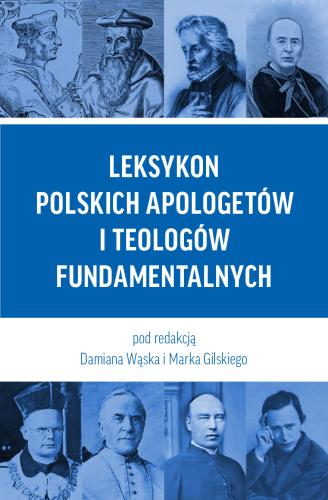
Lexicon of Polish Apologists and Fundamental Theologians
Keywords:
apologetics, fundamental theology, credibility of Christianity, Revelation, ecclesiology, Catholic Church, PolandSynopsis
Accounts of Polish intellectual culture usually overlook theologians, although for centuries they took part in national and international debates on truth, rational knowledge and humanity’s place in the world. Apologists and, more recently, fundamental theologians played a special role among them, engaging with new currents of thought, the natural sciences and other religions and denominations. Many have been forgotten, some of their works still await translation from Latin or a new edition, and no study has traced the development of apologetics in Poland as a coherent history of ideas. The lexicon seeks to fill this gap and to restore the most important figures to their rightful place in Polish humanities and theology. Prepared by theologians, Church historians, philosophers and historians of ideas, drawing on archival research, conferences and expert consultations, it covers seven centuries, from the fourteenth to the twenty-first. It is arranged chronologically in four parts, each introduced by an outline of the period’s historical, religious and philosophical context, and contains 23 entries on deceased apologists active in the Polish lands. Each entry follows a uniform three-part structure – biographical and bibliographical context, the author’s method and the main apologetic themes – with a selected bibliography and an English summary. The lexicon traces a path from the medieval apology of Church unity, in which Matthew of Kraków and Peter Wysz helped to lay the foundations of European conciliarism, through Reformation-era polemics and the nineteenth-century dialogue with science and disputes with Darwinism, materialism and positivism, to total and personalist apologetics. It ends with contemporary fundamental theology, which rests on witness and builds the credibility of Christianity, Revelation and the Catholic Church in dialogue even with those who hold non-Christian worldviews. Polish theology emerges as a mosaic of centres – from medieval Kraków to the schools of Lwów, Lublin and Warsaw – in which questions of faith, ecclesiology and the place of Christianity in culture recur across the centuries. The lexicon reveals the continuity of Polish apologetic thought and shows how Christianity in Poland defined its identity, diagnosed the crises of each period and pointed to paths of renewal.
Chapters
-
Introduction
-
The Fourteenth and Fifteenth Centuries
-
Anonymous – Utrum Deus gloriosus
-
Matthew of Kraków
-
Peter Wysz of Radolin
-
Jacob of Paradies
-
Benedict Hesse of Kraków
-
The Sixteenth Century
-
Stanislaus Hosius
-
Marcin Kromer
-
Piotr Skarga
-
The Seventeenth to Nineteenth Centuries
-
Stefan Zachariasz Pawlicki
-
Józef Sebastian Pelczar
-
Marian Ignacy Morawski
-
Karol Antoni Niedziałkowski
-
The Twentieth and Twenty-First Centuries
-
Maciej Sieniatycki
-
Szczepan Szydelski
-
Piotr Kremer
-
Konstanty Józef Michalski
-
Wincenty Kwiatkowski
-
Ryszard Paciorkowski
-
Eugeniusz Tomaszewski
-
Edward Kopeć
-
Stanisław Nagy
-
Marian Rusecki
-
Czesław Stanisław Bartnik